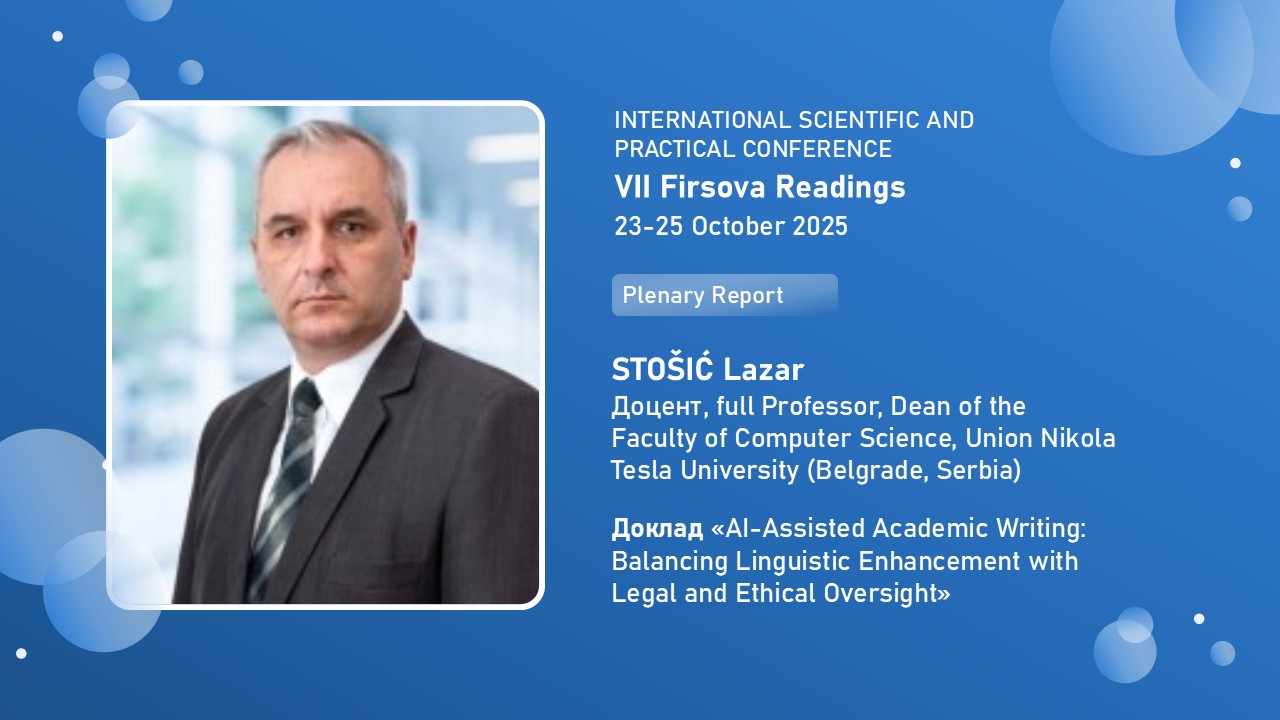
AI-Assisted Academic Writing: Balancing Linguistic Enhancement with Legal and Ethical Oversight Radoslav BALTEZAREVIĆ, Lazar STOŠIĆ and Оlga В. MIKHAILOVA
In the age of digitalization, artificial intelligence (AI) has become a disruptive force that affects not just businesses but also academic writing. AI has the power to fundamentally alter the way academics perform scientific research, from improving the accuracy and efficacy of scientific forecasts to automating certain tasks and elevating the general caliber of academic writing. When it comes to fulfilling the writing requirements, AI solutions are frequently more efficient than conventional approaches. The purpose of this article is to reveal the possibilities and risks of using artificial intelligence based on a theoretical analysis of modern research and to propose safety standards and criteria for using artificial intelligence in scientific work. By producing grammatically sound sentences, developing creative ideas, and adapting language to academic style norms, AI tools enhanced performance in this area. Furthermore, research tools driven by AI can speed up discoveries, provide insights, and automate tedious processes. However, academic writing has undergone significant change as a result of AI, and its implications have sparked ethical and legal questions. The swift proliferation of AI technology is compelling educational establishments worldwide to incorporate these innovative resources into their research methodologies and curricula. This integration highlights the importance of carefully analyzing the ways in which these new technologies impact academic environments’ originality, authorship, and academic integrity. Nonetheless, creating comprehensive regulations can aid in fostering an atmosphere that embraces AI’s benefits while upholding the ethical research norms that are essential to academic society.